
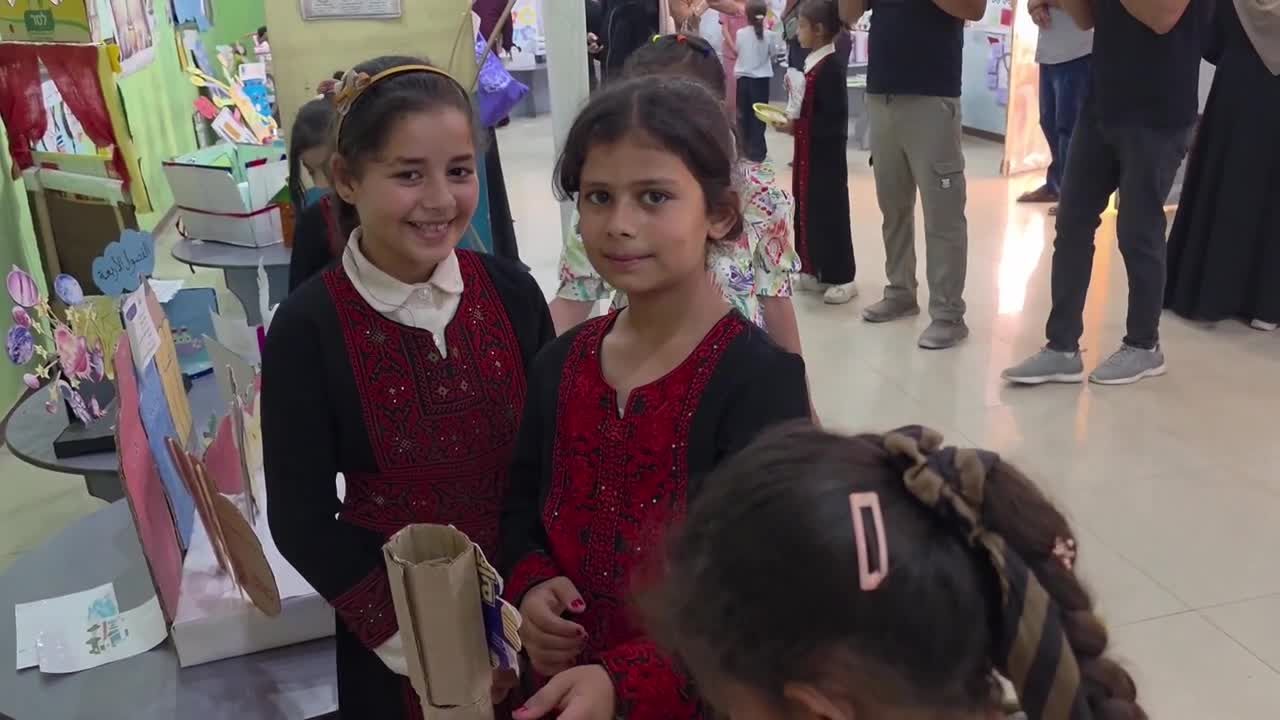
In Khan Younis, the “Golden Fingers” exhibition was inaugurated with the participation of four educational centers, aiming to display teaching aids and educational tools produced from locally sourced materials and recycled resources. This initiative seeks to address the severe shortage of educational supplies currently affecting the education sector in Gaza.
The exhibition comes amid the exceptional circumstances in the Gaza Strip, where educational staff have worked to develop low-cost teaching alternatives that support the educational process and enhance children’s learning environment.
Dr. Abeer Al-Masri, the educational supervisor and exhibition director, stated that the exhibition features eight educational stations covering Arabic, mathematics, English, health, guidance, and psychological support, in addition to stations dedicated to artificial intelligence and creative talents. She explained that the event aims to highlight the creativity of teachers, students, and parents in utilizing available resources to produce meaningful educational tools.
She added that approximately 800 students and 60 teachers and staff members participated in preparing the exhibition, after undergoing specialized training workshops in designing and producing educational aids using simple, locally available materials.
Dr. Al-Masri noted that the exhibition seeks to boost students’ self-confidence, develop their creative skills, and discover their talents, while also encouraging teamwork and transforming challenges facing the educational process into opportunities for learning and innovation.
Meanwhile, teacher Ghaydaa Al-Nawajha explained that the artificial intelligence station included the use of various digital applications and tools to produce interactive stories, videos, and educational presentations, as well as designing innovative educational aids using specialized software and hologram technologies made from recycled materials.
She emphasized that incorporating artificial intelligence has helped simplify the educational process and increase student engagement with the curriculum, especially given the limited available resources. She pointed out that these initiatives reflect the ability of teachers and students to innovate despite the difficult conditions in the region.
The exhibition featured dozens of interactive educational models and aids made from recycled materials, aiming to promote a culture of creativity and maximize the use of available resources to serve the educational process.