
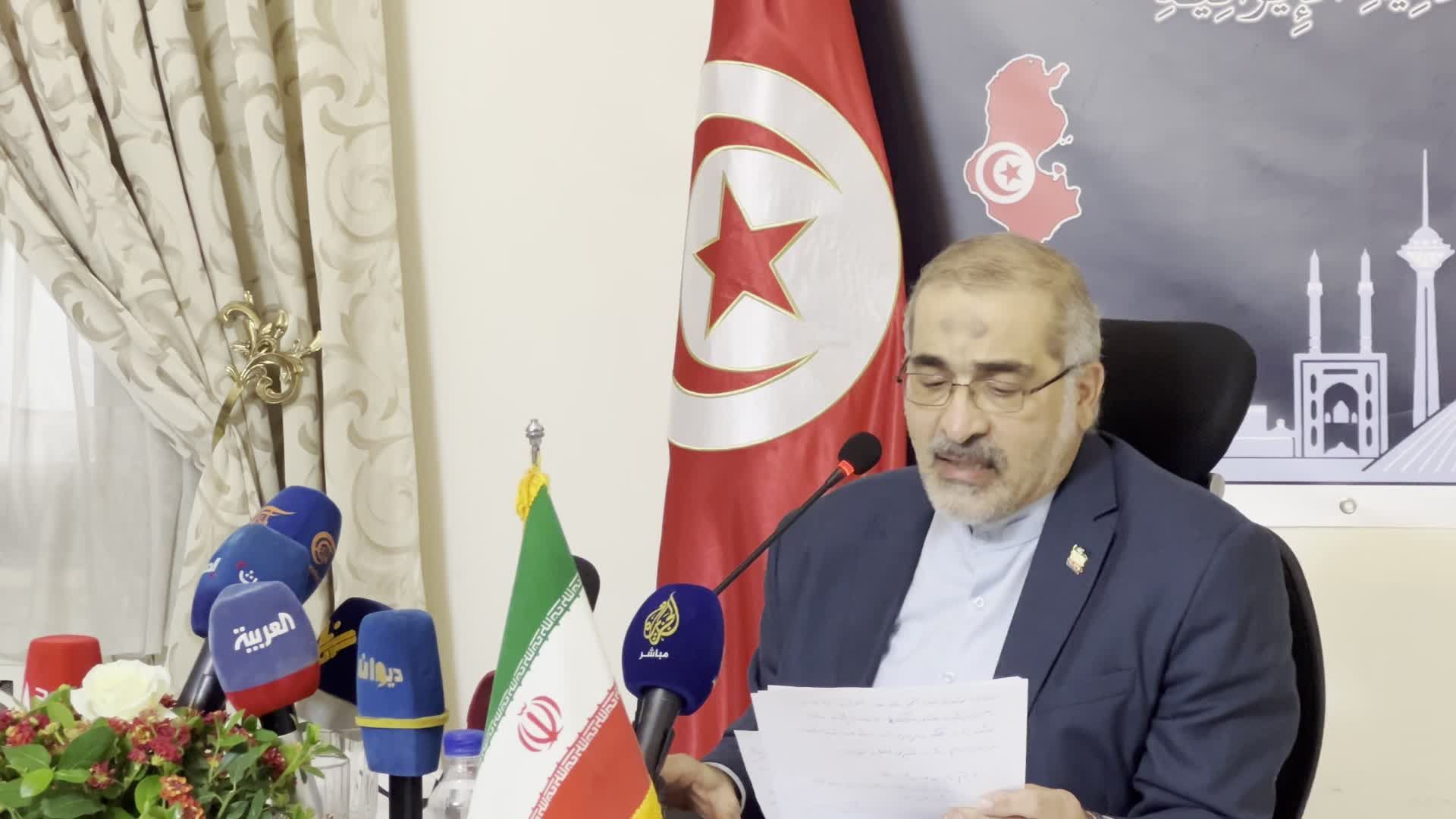
During a press conference held on Friday at his residence in Tunis, the Iranian Ambassador to Tunisia, Mir Masoud Hosseinian, addressed a range of domestic and international issues. He affirmed that the Iranian people's demands for a dignified life are legitimate and stated that the government is committed to resolving economic challenges and improving conditions through dialogue.
Ambassador Hosseinian reported that security has been restored, particularly in the capital Tehran, which is now calm following a recent wave of protests over living conditions. He expressed hope for economic improvement through a package of reforms and decisions, despite the sanctions imposed on Iran and high inflation rates. He emphasized dialogue with civil and political society components as the optimal path to meet the people's aspirations, improve development and economic indicators, and secure citizens' livelihood needs—a goal he described as common to all nations seeking prosperity.
The Ambassador noted that from the first day of the protests, President Masoud Pezeshkian instructed relevant ministries to establish a foundation for dialogue with various unions and economic, commercial, and financial structures to hear their concerns. This effort, he stated, was part of an initiative to calm the situation, reduce violence, and continue parliamentary and governmental work on necessary measures to mitigate economic problems and help economic actors, especially merchants and business owners.
He further highlighted intensive meetings held by the head of the judiciary, Gholam-Hossein Mohseni-Eje'i, with economic stakeholders to prioritize dialogue, contain crises, and enhance social unity and peace—a process he acknowledged requires sufficient effort and time.
Ambassador Hosseinian also addressed the role of external factors, alleging that certain foreign parties exacerbated social tensions in Iran. He criticized what he termed "provocative" media statements by some foreign officials, which he claimed encouraged protest and civil disobedience under the pretext of defending civil rights. He asserted that the aim of these "irresponsible" actions was to exploit chaos and violence to overthrow the established system, including through the funding of outlaw groups. The Ambassador stated that Foreign Minister Abbas Araghchi recently presented evidence of such foreign interference to Western ambassadors in Tehran, and that all such attempts had failed against the Iranian people's national unity.
Conversely, he pointed to recent pro-government demonstrations and preparations for a massive rally marking the 47th anniversary of the Islamic Revolution as evidence of the people's patriotism and commitment to peace and lasting security.
Regarding regional tensions and fears of aggression following last June's 12-day war, Ambassador Hosseinian stated that Iran does not seek war or confrontation but is fully prepared to counter any potential aggression. He called for de-escalation and rational action to preserve regional and international interests.
In conclusion, he commended the role of several Arab and Islamic nations, including Saudi Arabia, Turkey, and Qatar, in supporting a dialogue-based approach to reach solutions that preserve all parties' interests and establish peace. He referenced direct and indirect talks with the United States and Western countries, aimed at avoiding war and reviving diplomacy, which he described as the best way to build trust and enhance communication channels based on mutual respect.