
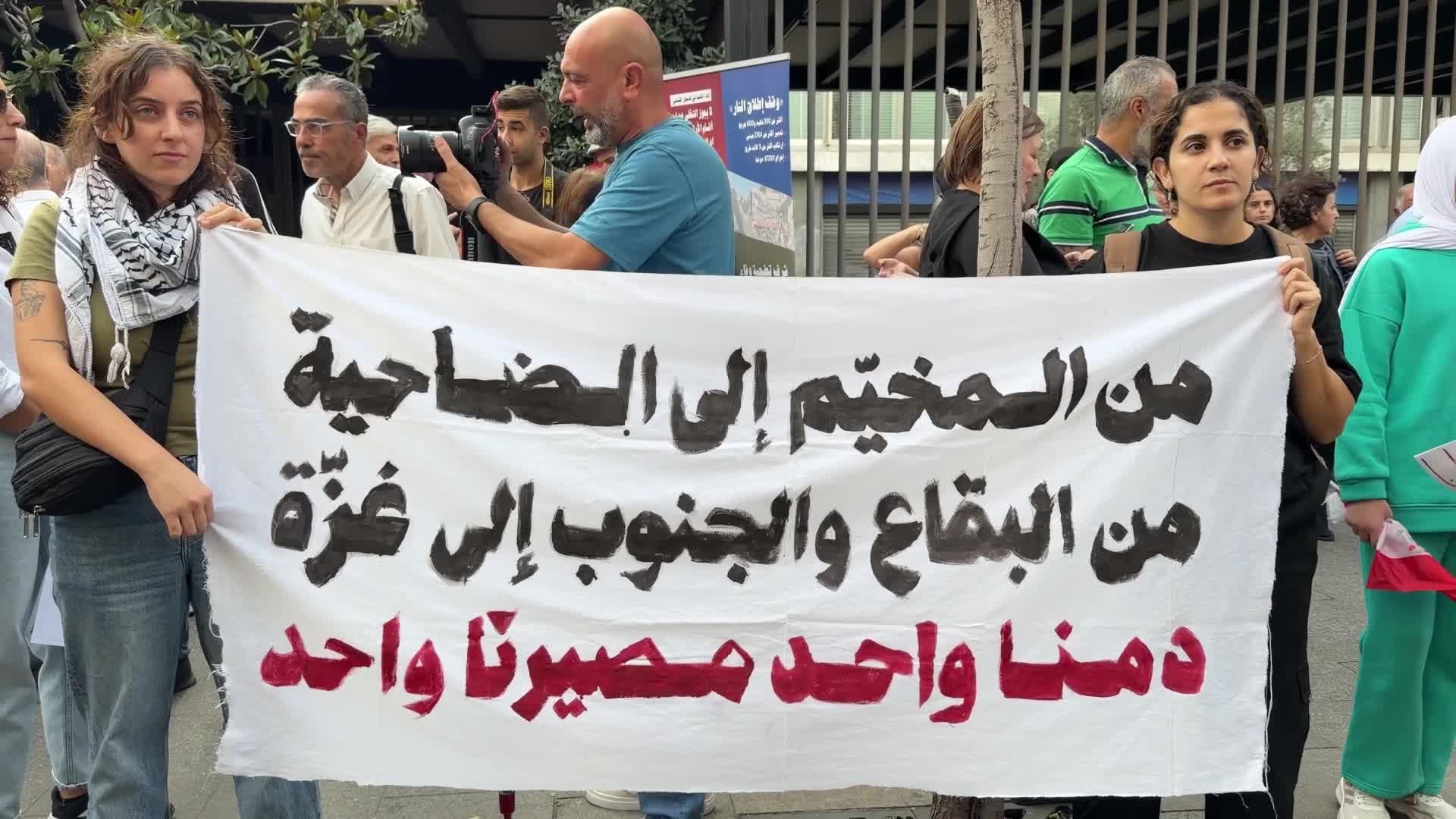
On Monday afternoon, 25th November 2025, a protest took place in the Lebanese capital of Beirut. Organized by a coalition of journalists and activists, the demonstration denounced repeated Israeli violations of Lebanese territory following the recent ceasefire agreement. A primary demand of the gathering was the release of Lebanese citizens detained in Israeli prisons.
The march commenced at noon in the Hamra district, originating in front of the Fransabank building near the Central Bank of Lebanon. The event drew dozens of participants, including recently released activist Georges Abdallah, alongside various political, intellectual, and media figures.
Protestors proceeding along Hamra Street carried Lebanese and Palestinian flags, as well as the banners of several political parties. Signs condemned the ongoing Israeli military actions in southern Lebanon, asserting that no sectarian community is safe from these attacks. The demonstration was accompanied by loudspeakers broadcasting enthusiastic anthems.
Participants chanted slogans emphasizing the necessity of maintaining a resistance to counter the occupation and liberate Lebanese land. They also expressed solidarity with the Lebanese Army.
Further demands called upon the Lebanese state to take serious and immediate action to secure an Israeli withdrawal from the occupied southern territories and to initiate the reconstruction of damaged areas.
During the event, activist Georges Abdallah delivered a speech in which he argued that national identity is contingent upon unwavering support for the "resistance's gun," which he described as the primary guarantor of Lebanese sovereignty. He urged broader public participation in such movements, citing recent Israeli aggressions in the Dahiya and Sidon areas as a pressing motivation.
Abdallah also emphasized that confronting normalization with Israel is a necessary first step for national defense. He expressed confidence that popular movements would ultimately overcome pressures toward normalization. He characterized Israel as representing "the barbarism of fascism" in the eyes of the world and praised the "Islamic Resistance" as a foundational force in building a "national state of resistance," paying tribute to the martyred leader Haitham al-Tabatabai as a pillar of national identity.
The protest served as a broader condemnation of perceived American interference in Lebanon's internal affairs and a rejection of ongoing Israeli military actions, including daily violations, arrests of Lebanese citizens, and the systematic destruction of border villages.